A refrigerator that isn’t cooling properly can make you think the worst. Many homeowners immediately assume the compressor has failed, but that’s rarely the first thing I suspect.
One repair I’ve made countless times involves the evaporator fan motor. When this small fan stops circulating cold air, the freezer may continue to freeze normally while the refrigerator section gradually warms up. It’s a frustrating problem because the appliance appears to be working, yet your groceries tell a different story.
I remember helping a homeowner who was ready to replace a six-year-old refrigerator because milk kept spoiling. The freezer was still making ice, which didn’t seem to make sense. Within a few minutes, I found the refrigerator evaporator fan had seized. After replacing a relatively inexpensive motor, the refrigerator was cooling normally again by the next day.
If you’ve noticed similar symptoms, checking the evaporator fan is one of the smartest places to start.
Key Takeaways
- A warm refrigerator paired with a cold freezer often points to a failing evaporator fan.
- Grinding, buzzing, or rattling noises may indicate worn motor bearings or ice interfering with the fan blade.
- Most replacement evaporator fan motors cost between $20 and $60.
- Replacing the motor usually takes 45 to 60 minutes with basic hand tools.
- Always disconnect power before opening any interior panels.
DIY Difficulty: Moderate (3/5)
Estimated Time: 45–60 minutes
What Does an Evaporator Fan Do?
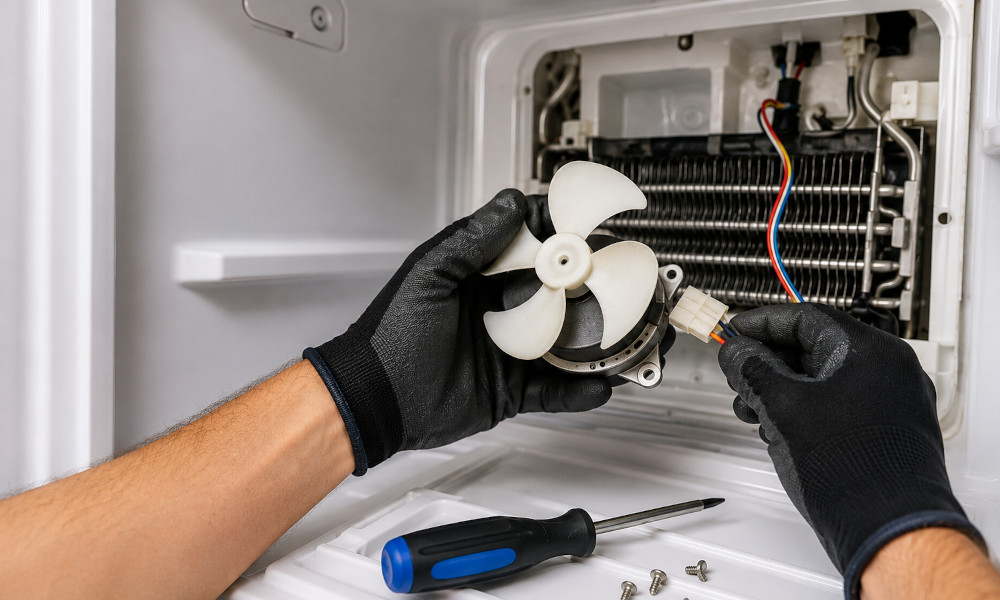
The evaporator fan is mounted behind the rear panel inside the freezer compartment. Its job is simple but essential. It pulls air across the evaporator coils and distributes that chilled air throughout both the freezer and fresh food compartments.
Without the fan, the evaporator coils can still become extremely cold, but the refrigerator has no efficient way to move that cold air where it’s needed. As a result, the freezer often stays frozen while the refrigerator slowly climbs above safe food storage temperatures.
For most refrigerators, the freezer should remain close to 0°F (-18°C), while the refrigerator compartment should stay between 35°F and 38°F (1.7°C to 3.3°C). If the refrigerator section is consistently warmer than the rest, poor airflow is often the reason.
Signs Your Refrigerator’s Evaporator Fan May Be Failing
The fan motor usually gives plenty of warning before it quits completely.
Some of the most common symptoms include:
- The refrigerator compartment feels warm while the freezer continues freezing food.
- Airflow from the refrigerator vents becomes noticeably weaker.
- You hear grinding, buzzing, squealing, or rattling coming from behind the freezer panel.
- The fan blade struggles to spin or stops unexpectedly.
- Frost or ice forms around the fan assembly.
Sometimes the noises come and go. A fan with worn bearings may squeal when it starts before becoming quieter, while frost buildup may cause intermittent buzzing as the blade strikes accumulated ice.
These symptoms don’t automatically guarantee the evaporator fan has failed, but when several occur together, it’s usually the first component I inspect.
Quick Troubleshooting Guide
| Symptom | Most Likely Cause |
| Refrigerator warm, freezer cold | Failed evaporator fan motor |
| Grinding or squealing | Worn motor bearings |
| Buzzing with visible frost | Ice interfering with the fan blade |
| Fan blade won’t rotate freely | Seized motor |
| Weak airflow from refrigerator vents | Fan not circulating cold air |
Evaporator Fan vs. Condenser Fan: What’s the Difference?
Many homeowners confuse these two fans because both affect cooling.
The evaporator fan is located inside the freezer and moves cold air throughout the refrigerator. When it fails, the freezer may still seem cold while the refrigerator compartment warms up.
The condenser fan, on the other hand, sits near the compressor underneath or behind the refrigerator. Its job is to cool the compressor and condenser coils by moving warm air away from the appliance.
If both compartments are struggling to cool and the refrigerator feels unusually hot underneath, the condenser fan could be the real problem instead.
Understanding which fan is responsible can save you from replacing the wrong part.
Tools You’ll Need
Gather everything before you begin so you won’t have to stop halfway through the repair.
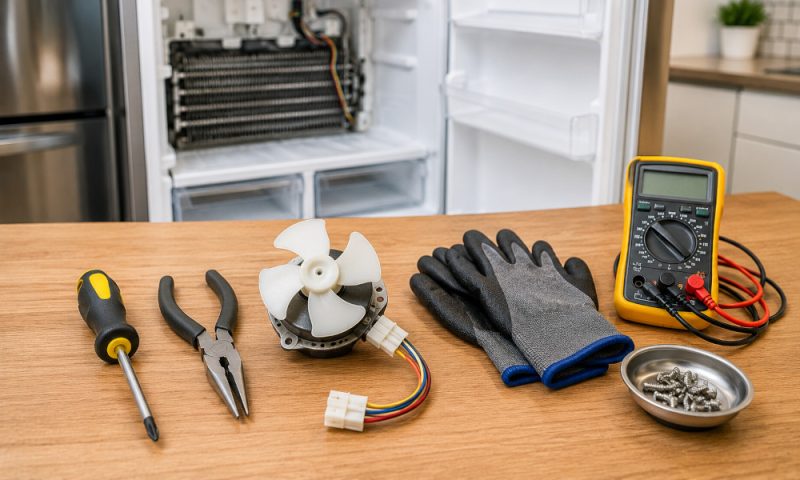
You’ll need:
- Phillips screwdriver
- Needle-nose pliers
- Work gloves
- Replacement evaporator fan motor designed for your refrigerator model
- Multimeter (recommended for electrical testing)
One habit that’s saved me countless headaches is taking a quick photo of every wiring connection before unplugging anything. Even simple connectors can be easy to forget once everything has been taken apart.
How to Diagnose and Replace an Evaporator Fan
Step 1: Disconnect the Power
Always unplug the refrigerator before removing panels or handling electrical components.
This repair isn’t particularly complicated, but working on a live appliance creates an unnecessary safety risk. While refrigerators are generally considered lower-risk than ovens, ranges, or toasters, it’s still important to follow safe repair practices. If you’re interested in improving overall kitchen safety, our guide to kitchen appliances that can start a fire explains which appliances pose the greatest fire risks and how to reduce those risks.
Once the refrigerator is safely unplugged, you can begin removing the freezer panel.
Step 2: Remove the Rear Freezer Panel
Open the freezer and remove any shelves or drawers that block access to the rear panel.
Most refrigerators use four to six Phillips screws to secure the panel. After removing them, carefully pull the panel forward to expose the evaporator coils and fan assembly.
If the panel feels stuck, don’t force it. Ice buildup can sometimes hold it in place. Letting the freezer thaw slightly often makes removal much easier.
Step 3: Inspect the Fan Assembly
Before assuming the motor has failed, take a close look at the fan itself.
If the blade is covered in frost, let the ice melt naturally or use a hair dryer on its lowest setting while keeping it moving constantly. Concentrating heat in one spot can damage plastic liners and nearby components.
Once the ice has cleared, spin the fan blade by hand.
A healthy fan should rotate freely with very little resistance.
If the blade feels stiff, wobbles excessively, or refuses to turn, the motor is likely nearing the end of its life.
I once inspected a refrigerator where the homeowner had already purchased a replacement motor. After thawing the heavy ice around the fan, the original motor spun perfectly. The real culprit turned out to be a damaged door gasket that kept allowing humid air into the freezer.
Taking a few extra minutes to inspect everything can prevent unnecessary repairs.
Step 4: Test the Motor
If you have a multimeter, disconnect the motor and test it for continuity according to the manufacturer’s specifications.
A motor that fails the continuity test should be replaced.
Even without a meter, certain warning signs strongly suggest the motor has failed:
- Grinding bearings
- Loud buzzing during operation
- Fan blade that barely turns
- No movement despite receiving power
If the motor appears healthy but frost continues building around the fan, the issue could involve the defrost system rather than the fan itself. That’s worth investigating before ordering replacement parts.
Step 5: Order the Correct Replacement Motor
Locate your refrigerator’s model number, usually found inside the fresh food compartment or along the door frame.
Search using the complete model number followed by “evaporator fan motor.”
Although universal replacements are available, I’ve consistently had better results using OEM replacement parts. They fit correctly, install more easily, and generally last longer than many generic alternatives.
Step 6: Install the New Evaporator Fan Motor
Once you’ve confirmed the motor is faulty, disconnect the wiring harness by pressing the locking tab rather than pulling the wires. Tugging on the wiring can damage the connector and create another repair you didn’t have before.
Remove the mounting screws or retaining clips holding the old motor in place, then install the new one using the same hardware. Reattach the fan blade, making sure it’s fully seated on the motor shaft and spins without rubbing against the housing.
Before reinstalling the freezer panel, rotate the blade by hand one last time. It should turn smoothly and clear nearby components without resistance.
Step 7: Reassemble and Test the Refrigerator
Reinstall the rear freezer panel, replace any shelves or drawers you removed, and plug the refrigerator back into the outlet.
Don’t expect temperatures to return to normal immediately. Most refrigerators need several hours to begin cooling properly and up to 24 hours to fully stabilize after being unplugged.
During that time:
- Listen for the evaporator fan cycling on and off normally.
- Check that you can feel cold air flowing from the refrigerator vents.
- Monitor temperatures with an appliance thermometer if possible.
If the refrigerator still isn’t cooling after a full day, another component may be responsible for the problem.
When the Fan Isn’t the Problem
An evaporator fan isn’t always the culprit behind cooling issues.
If replacing the motor doesn’t restore normal performance, consider these possibilities:
| Symptom | Possible Cause |
| Heavy frost covering the evaporator coils | Defrost system failure |
| Both the refrigerator and freezer are warm | Compressor or sealed system issue |
| Compressor runs constantly | Dirty condenser coils or low refrigerant |
| Refrigerator cycles normally, but the airflow remains weak | Blocked air vents or a damaged air damper |
I’ve seen homeowners replace perfectly good fan motors only to discover the real issue was a failed defrost heater or thermostat. Spending a few extra minutes diagnosing the symptoms before ordering parts can save both time and money.
If your refrigerator needs a compressor replacement, a sealed-system repair, or several major components replaced at once, replacing it may be the smarter long-term investment. Before making that decision, take a look at our guide to the best refrigerators to buy in 2026, which compares popular refrigerator styles, reliability, and repair trends.
A Quick Safety Reminder
This repair is considered manageable for many homeowners, but safety should always come first.
Disconnect power before opening any panels, wear gloves when working around sheet metal, and avoid using excessive heat when melting ice. Plastic liners and wiring insulation can be damaged surprisingly quickly.
Why Atlanta Refrigerators Often Develop Frost Problems
One thing I’ve noticed while working on refrigerators throughout metro Atlanta is how much our climate affects appliance performance.
During Georgia’s hot, humid summers, every time someone opens the refrigerator, warm, moisture-filled air enters the freezer compartment. That moisture freezes onto the evaporator coils and around the fan assembly.
After enough frost builds up, airflow becomes restricted. Eventually, the fan blade may begin striking the ice, producing buzzing or clicking sounds before stopping altogether.
I’ve encountered this in homes throughout Marietta, Roswell, Alpharetta, Johns Creek, and Buckhead, especially during backyard barbecue season when refrigerator doors are opened repeatedly throughout the day.
If your evaporator fan keeps icing over every few months, don’t immediately assume the replacement motor is defective. A worn or torn door gasket may be allowing humid air to enter, causing the same problem to recur.
Common Mistakes to Avoid
Assuming the Compressor Has Failed
A refrigerator that isn’t cooling doesn’t automatically need an expensive compressor replacement.
If the freezer is still freezing food while the refrigerator warms up, I always investigate the evaporator fan first because it’s one of the most common and affordable repairs.
Replacing Parts Before Confirming the Problem
It’s tempting to order replacement parts after watching a few online videos, but similar symptoms can have very different causes.
Checking the fan blade, airflow, and frost pattern before buying parts often prevents unnecessary repairs.
Ignoring the Door Gasket
A damaged door seal allows humid air to enter the freezer every time the compressor runs.
That moisture freezes around the evaporator fan, forcing it to work harder until airflow becomes restricted again.
Pulling on Electrical Wires
Always disconnect wiring by releasing the locking tab on the connector.
Pulling directly on the wires can damage the harness and turn a simple repair into a much larger project.
When to Call a Professional
DIY repairs make sense when the problem is clearly limited to the evaporator fan motor.
However, professional service is usually the better choice if you discover:
- Refrigerant leaks
- Damaged refrigerant lines
- Burned electrical wiring
- A failed compressor
- Sealed system problems
- Repeated frost buildup after replacing the fan
These repairs require specialized tools and training.
If you’re looking for appliance repair in Marietta or elsewhere in metro Atlanta, Appliance EMT has built a strong reputation for accurate diagnostics and dependable refrigerator repairs when the job extends beyond routine maintenance.
Frequently Asked Questions
Can I keep using my refrigerator if the evaporator fan isn’t working?
Only for a short time.
The freezer may continue keeping frozen food cold, but the refrigerator compartment will eventually rise above the recommended storage temperature. Promptly repairing the problem helps prevent food spoilage.
How much does an evaporator fan motor cost?
Most replacement motors cost between $20 and $60, depending on the refrigerator model.
Hiring a technician typically brings the total repair cost to $150-$250, including labor.
Why is my freezer cold but my refrigerator warm?
This is one of the clearest signs that the evaporator fan isn’t circulating cold air into the fresh food compartment.
Other airflow problems, such as blocked vents or severe frost buildup, can produce similar symptoms, so it’s worth checking those at the same time.
How do I find the correct replacement motor?
Locate the refrigerator’s model number inside the fresh food compartment or along the door frame.
Search using the full model number and “OEM evaporator fan motor“ to find the correct replacement.
Can dirty condenser coils cause similar cooling problems?
Yes.
Dirty condenser coils reduce overall cooling efficiency and force the compressor to work harder. While they don’t usually cause the classic “warm refrigerator, cold freezer” symptom on their own, cleaning the coils is worthwhile whenever you’re troubleshooting cooling issues.
Final Thoughts
A faulty evaporator fan motor can make it seem like your refrigerator is nearing the end of its life, but that’s often far from the truth. Because the fan is responsible for moving cold air throughout the appliance, even a small motor failure can cause noticeable cooling problems while the compressor continues to run normally.
Taking time to inspect the fan, check for frost buildup, and verify the diagnosis before replacing parts can save you hundreds of dollars and prevent unnecessary repairs. In many cases, replacing the fan motor is a straightforward project that restores proper airflow and extends the refrigerator’s lifespan.
If you discover more complex issues during the repair, such as electrical damage, sealed-system problems, or recurring frost buildup, don’t hesitate to call a qualified technician. Getting an accurate diagnosis early can prevent minor problems from turning into expensive repairs later.
About the Author