
Allison checks the temperature display on a wine cooler before moving on to more advanced troubleshooting.
There are some appliances in my house that I would notice immediately if they stopped working. The refrigerator is obviously one of them. The washing machine is another, especially in a house with kids.
A wine cooler is a little different.
It can look perfectly normal from the outside while the temperature inside slowly starts creeping upward. The light still comes on. The display may still be working. You might even hear the unit running.
Meanwhile, the wine you bought the cooler to protect is sitting at the wrong temperature.
I started looking more closely at wine cooler problems after talking with Handyman Bob about the smaller refrigeration appliances people keep in kitchens, basements, bars, and entertainment rooms. What surprised me was how many cooling problems can start with something relatively simple.
Before assuming the entire wine cooler has failed, there are several things a homeowner can safely check.
Bob also made an important distinction: checking airflow, settings, seals, and cleanliness is one thing. Taking apart a refrigeration system is something else entirely.
Here is where I would start.
Table of Contents
Quick Answer: Why Is My Wine Cooler Not Cooling?
If a wine cooler is running but not getting cold enough, start by checking:
- The temperature setting
- Door closure and the door gasket
- Airflow around the cooler
- Interior air circulation
- Dust around accessible vents
- Whether the room is unusually hot
- Whether bottles are blocking interior vents
- Frost, condensation, or unusual noises
If those basic checks don’t solve the problem, the wine cooler could have an issue with a temperature sensor, fan, electronic control, compressor, or another part of the cooling system.
Those problems are better diagnosed by someone who works on refrigeration appliances.
First, Make Sure the Wine Cooler Is Actually Too Warm
This sounds obvious, but Bob’s first advice was not to start taking things apart just because the cabinet doesn’t feel as cold as a kitchen refrigerator.
A wine cooler isn’t necessarily supposed to feel refrigerator-cold.
Its job is to maintain the temperature selected for the wine being stored, and the correct setting can vary according to the wine, the cooler, and how you’re using it.
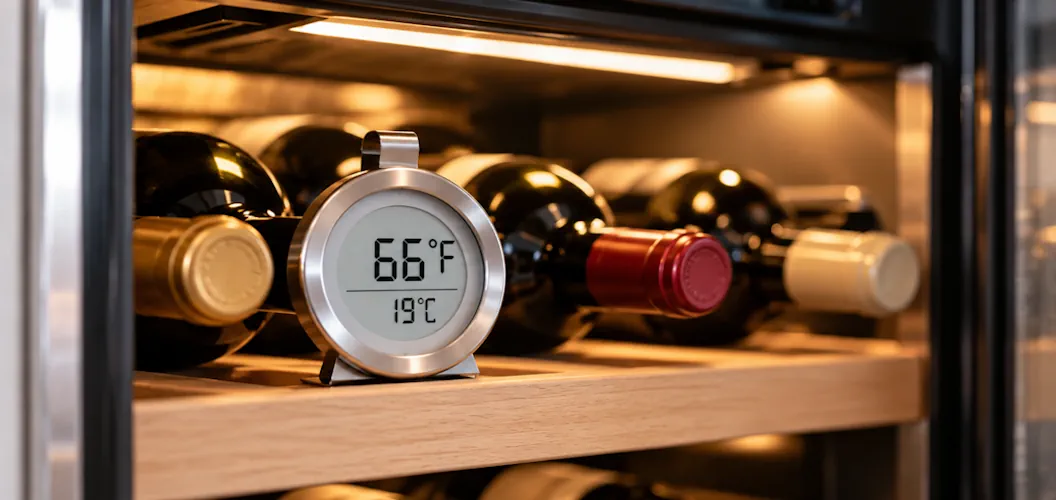
Start with the temperature display.
Check the setting against the owner’s manual for your particular model. If you’re unsure whether the display is accurate, an inexpensive refrigerator thermometer can give you a second temperature reading inside the cabinet.
Give the cooler enough time to stabilize before deciding something is wrong. Opening the door repeatedly while checking the temperature only makes that harder.
That’s a lesson I have learned with my regular refrigerator too: sometimes our attempts to figure out why an appliance isn’t cold enough involve opening the door every five minutes and letting more warm air inside.
1. Check Whether Someone Changed the Temperature Setting
With kids in the house, I’ve learned never to rule out the simplest explanation.
Buttons get pressed.
Settings get changed.
If your wine cooler suddenly seems warmer than usual, check the control panel before doing anything else.
Make sure:
- The desired temperature is still selected.
- The cooler hasn’t been placed into a different operating mode.
- A dual-zone cooler has the appropriate setting for each compartment.
- The controls aren’t locked or displaying an error.
If you recently lost power, it’s also worth confirming that the cooler returned to its normal settings afterward.
Bob’s advice here is simple: verify the easy things before diagnosing the expensive things.
That applies to almost every appliance in a house.
2. Make Sure the Door Is Closing Completely
A wine cooler door that is slightly open can create a surprisingly big cooling problem.
Look closely at the door rather than simply pushing it shut.
A bottle may be sticking out just far enough to prevent the door from sealing. A shelf might not be seated correctly. The cooler itself could also be sitting unevenly and affecting how the door closes.
Then inspect the gasket, which is the flexible seal running around the door.
Look for:
- Food, dirt, or sticky residue
- Sections of the gasket pulling away
- Cracks or tears
- Areas that appear flattened
- Obvious gaps when the door is closed
You can clean a dirty gasket gently with warm water and mild soap, then dry it.
A damaged gasket is a different issue.
Bob explained that when warm room air continually gets past a bad seal, the cooling system has to work harder to maintain its temperature. So the door seal isn’t just about keeping cold air inside. It affects how hard the appliance has to work.
3. Give the Wine Cooler Room to Breathe
This is one of those maintenance issues that’s easy to overlook because once we find the perfect spot for an appliance, we tend to leave it there.
Wine coolers need ventilation.
Exactly how much clearance is required depends on whether you have a freestanding or built-in model and how that specific unit is designed. This is one area where I would follow the manufacturer’s installation instructions instead of relying on a universal rule.
A freestanding wine cooler shouldn’t automatically be pushed tightly into a cabinet opening just because it happens to fit.
Check for objects blocking the ventilation areas, and make sure the cooler is installed the way its manufacturer intended.
Bob pointed out that refrigeration appliances have to get rid of heat somewhere. Restricting that process can make cooling more difficult.
4. Check the Room Around the Cooler
Where you put a wine cooler matters too.
If it’s sitting in direct afternoon sunlight, beside an oven, near another heat-producing appliance, or inside a room that gets extremely hot, it may have a harder time maintaining its set temperature.
This can be especially important in Georgia.
I live in the Metro Atlanta area, and there are rooms here that can become surprisingly hot during summer. Garages, enclosed porches, bonus rooms, and poorly conditioned spaces don’t always maintain the same temperature as the rest of the house.
Check your owner’s manual for the environment in which the manufacturer says the cooler should operate.
If the unit performs normally most of the year but struggles every summer, its location deserves a closer look.
5. Don’t Pack Bottles Against the Interior Vents
I understand the temptation to squeeze one more bottle into a wine cooler.
If there is technically room, why not?
Airflow is one reason.
Cold air needs to circulate through the cabinet. If bottles are packed tightly against an interior vent or fan area, temperatures may become uneven.
One section of the cooler might seem fine while another runs warmer.
Take a look at how the bottles are arranged and make sure you’re not covering obvious air passages.
If the owner’s manual shows a recommended loading arrangement, that’s worth following. Wine cooler shelves and bottle capacities aren’t always as flexible as they first appear.
6. Listen to What the Wine Cooler Is Telling You
Bob has taught me to pay more attention to appliance noises.
Not every sound means trouble. Refrigeration equipment normally cycles on and off and may make different sounds while operating.
What matters more is a change.
If your wine cooler suddenly starts making a sound you’ve never heard before, pay attention.
That could include:
- Repeated clicking
- Rattling that wasn’t there before
- A fan that sounds like it is hitting something
- An unusually loud hum
- The cooler repeatedly starting and stopping
Also pay attention to the opposite problem.
If the wine cooler is warm and normally makes operating sounds but has suddenly become completely silent, that’s useful information too.
You don’t have to diagnose the part yourself. Simply being able to tell a technician what changed can make troubleshooting easier.
7. Look for Frost or Excessive Condensation
A little moisture doesn’t necessarily mean your wine cooler is failing.
Excessive moisture is different.
If you notice water collecting inside, unusually heavy condensation, or frost forming where you don’t normally see it, start with the door.
Make sure it is closing properly and check the gasket again.
Also think about whether the door has been opened frequently or left open for an extended period.
If the frost or moisture keeps returning under normal use, I would stop treating it as a simple inconvenience. Something may be interfering with the cooler’s ability to maintain the proper conditions inside.
8. Clean the Areas the Manufacturer Says Homeowners Can Clean
Dust and pet hair have an amazing ability to find appliances.
I know that firsthand because we have a dog, and somehow dog hair manages to travel to places I’m fairly certain the dog has never visited.
Depending on your wine cooler’s design, there may be accessible exterior ventilation areas that collect dust over time.
Before cleaning anything, turn the unit off or unplug it if the manufacturer’s instructions tell you to do so.
Only clean areas intended to be maintained by the owner. Don’t remove refrigeration components or electrical covers just because you can see a few screws.
A soft brush or vacuum may be appropriate for some accessible exterior areas, but your owner’s manual should take priority.
This is one of the places where Bob draws a pretty clear DIY line: maintenance is not the same thing as appliance disassembly.
What I Wouldn’t DIY on a Wine Cooler
I’m comfortable cleaning things, inspecting things, reorganizing bottles, checking settings, and doing basic homeowner maintenance.
I am not interested in turning my wine cooler into a weekend refrigeration experiment.
If a problem appears to involve the compressor, refrigerant circuit, internal electrical components, control board, or a component that requires significant disassembly to access, that’s where I would call someone.
The same goes for a cooler that:
- Isn’t cooling after the basic checks above
- Runs almost constantly without reaching temperature
- Keeps tripping a circuit breaker
- Has a burning smell
- Has damaged wiring or electrical components
- Develops the same problem repeatedly
- Shows an error that the owner’s manual doesn’t resolve
Unplug the appliance and seek professional help if you notice obvious signs of an electrical or overheating problem.
Wine Enthusiast Cooler Not Cooling?
Brand and model matter once you get beyond basic troubleshooting.
Different wine coolers can use different control systems, sensors, fan arrangements, and refrigeration components. A generic internet fix isn’t automatically appropriate for every model.
If you own one of the brand’s units and the basic homeowner checks haven’t solved the cooling problem, this Wine enthusiast wine cooler repair resource is a logical next step for understanding professional repair options.
Before scheduling service, I would have the model number available and write down exactly what the cooler is doing.
For example:
The display is set to 55 degrees, but my thermometer shows 68 degrees. The fan is running, and the door seal looks good.
That is much more useful than simply saying, “My wine cooler is broken.”
Bob’s Advice: Troubleshoot the Symptom, Not Your Guess
One of the things I like about talking appliances with Bob is that he doesn’t immediately jump to the most dramatic explanation.
If a cooler isn’t maintaining temperature, that is the symptom.
It doesn’t automatically mean the compressor is bad.
There are several things that can contribute to a cooling problem, and a good diagnosis should determine the actual cause before parts start getting replaced.
For homeowners, that means documenting what you see.
Ask yourself:
- Is the cooler completely warm or just a few degrees off?
- Is it running?
- Is the fan running?
- Did the problem happen suddenly or gradually?
- Is there frost?
- Is there condensation?
- Does the door seal?
- Has the cooler recently been moved?
- Has the room become much warmer?
- Is an error code displayed?
Those details can help a technician narrow down the problem much faster.
How I Would Maintain a Wine Cooler Going Forward
Talking with Bob changed the way I think about appliance maintenance in general.
Most of us don’t need another complicated household maintenance schedule.
We just need to notice our appliances before they start screaming for attention.
For a wine cooler, I would make these habits part of normal home maintenance:
Keep the door gasket clean.
A quick wipe is much easier than dealing with a door that eventually stops sealing properly.
Check the vents periodically.
Make sure nothing is obstructing exterior or interior airflow.
Don’t overload the cabinet.
Give the cooler enough room to circulate air as designed.
Watch the temperature.
If you care enough about the wine to keep it in a dedicated cooler, periodically verifying the actual cabinet temperature makes sense.
Pay attention to new sounds.
A change in operation is often more useful than the sound itself.
Follow the manufacturer’s cleaning instructions.
Different designs have different maintenance requirements.
Deal with recurring problems.
If you keep resetting, unplugging, defrosting, or rearranging the cooler to make the same problem temporarily disappear, it’s probably time to find out what is actually wrong.
The same basic habits that help other refrigeration appliances last longer also apply here. Bob has a broader guide on how to maintain your home appliances before they break down that covers several of the maintenance habits I use around the house.
When Should You Call a Wine Cooler Repair Technician?
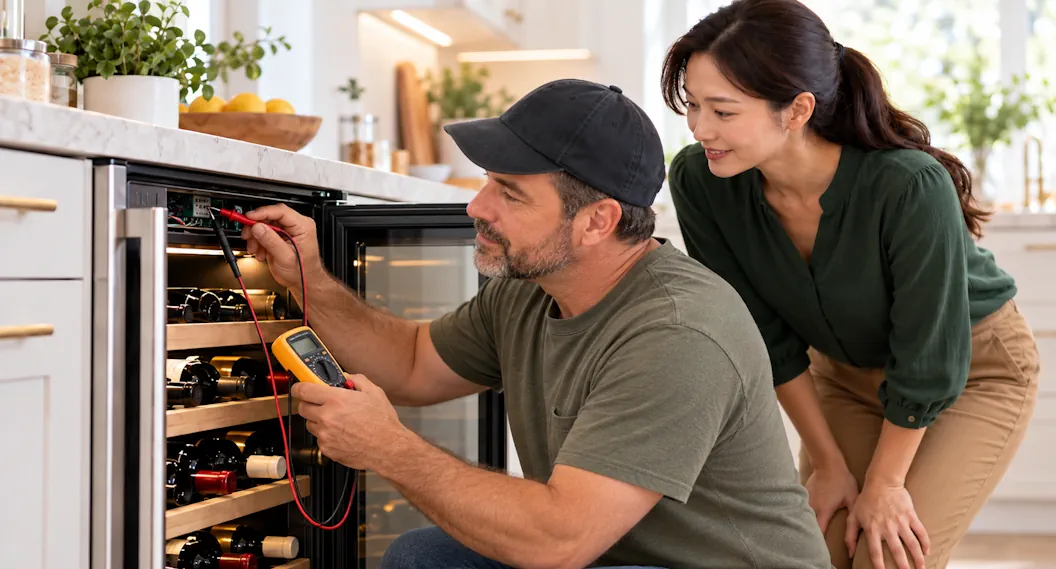
I would call a professional when the easy checks stop producing easy answers.
If the power is on, the settings are correct, the door seals properly, airflow isn’t blocked, and the unit still won’t maintain its temperature, continuing to guess probably isn’t accomplishing much.
That’s when actual diagnosis becomes more valuable than another troubleshooting video. However, ff your wine cooler is older or has started needing repeated repairs, Bob’s repair or replace an appliance checklist can also help you think through whether another repair makes sense.
A technician familiar with wine coolers can test components and determine why the unit isn’t cooling instead of replacing parts based on symptoms alone.
For anyone storing bottles that are difficult or expensive to replace, I also wouldn’t let a temperature problem drag on for days while experimenting with increasingly complicated DIY fixes.
Protect the wine first.
Then figure out the appliance.
Frequently Asked Questions
Why is my wine cooler running but not getting cold?
Possible causes range from relatively simple airflow, door-seal, temperature-setting, or environmental issues to problems involving a fan, sensor, control system, compressor, or cooling system. Start with the safe external checks before assuming a major component has failed.
Should a wine cooler feel as cold as my refrigerator?
Not necessarily. Wine coolers are designed to operate at temperatures appropriate for wine storage and serving rather than automatically matching a household refrigerator. Check the selected temperature and your manufacturer’s instructions.
Can a wine cooler stop cooling because it is too full?
Overloading can become a problem if bottles block vents or interfere with interior air circulation. Follow the manufacturer’s loading and clearance recommendations.
Why does my wine cooler have condensation inside?
Frequent door opening, humid air entering the cabinet, a door that isn’t closing completely, or a sealing problem can contribute to condensation. Persistent or excessive moisture deserves further investigation.
Can I repair a wine cooler myself?
Basic homeowner tasks such as checking settings, inspecting the door seal, cleaning approved accessible areas, confirming airflow, and rearranging bottles are reasonable starting points. Repairs involving electrical components or the refrigeration system are better left to someone qualified to diagnose and repair them.
Should I unplug a wine cooler that isn’t cooling?
If the cooler simply isn’t maintaining temperature, consult the manufacturer’s troubleshooting instructions first. If you notice overheating, a burning smell, damaged wiring, repeated breaker trips, or another potential electrical hazard, stop using the appliance and seek professional help.
Final Thoughts from Allison
I like troubleshooting household problems when there is something practical I can check myself.
A loose connection, dirty seal, blocked vent, or bad setting? Absolutely. Let me take a look.
But I’ve also learned that being comfortable with DIY doesn’t mean every repair should become a DIY project.
A wine cooler is still a refrigeration appliance. Once you’ve checked the temperature setting, door, airflow, placement, bottle arrangement, and basic maintenance items, there isn’t much value in randomly taking components apart.
That’s where Bob’s approach makes the most sense to me: start with what you can observe, eliminate the simple causes, and then get an actual diagnosis if the problem remains.
It saves you from replacing parts that aren’t broken, and more importantly, it gives those bottles in your wine cooler a better chance of staying exactly the way you intended.
About the Author