A handyman’s no-stress guide to deciding fast – using the 50/50 rule, appliance age, and a simple checklist.
When an appliance starts acting up, the big question isn’t “Can it be fixed?”. It’s “Is it worth fixing?” I’m Bob, a handyman with over 20 years of experience in Atlanta, and I’ve seen plenty of repairs that were quick wins… and plenty that turned into money pits.
In this guide, I’ll show you the same simple process I use to help homeowners decide: the 50/50 rule, what your appliance’s age usually means, and the warning signs that make replacement the smarter (or safer) move. By the end, you’ll have a quick checklist to confidently choose repair, replace, or “get a quote first” without guessing.
TL;DR: Repair vs Replace (the 5-minute decision)
- Repair if the quote is less than about 50% of the replacement price and the appliance is still within the first half of its expected lifespan.
- Replace if the unit is near or past its typical lifespan, has repeat breakdowns, or the repair is expensive compared with a new model.
- Replace immediately for safety issues (burning smells, sparks, electrical arcing, gas smell, major leaks near electrical parts).
- Check efficiency: compare the unit’s estimated kWh/year (EnergyGuide label) to newer models to see if a replacement pays back over time.
- When in doubt, pay for a professional diagnosis – it can prevent guesswork and surprise costs.
Repair vs Replace Appliance Calculator
Here is a cheat calculator if you want a fast way to know whether you should repair that appliance or buy a new one.
Repair vs Replace Appliance Calculator
Uses safety checks + the 50/50 rule + age/lifespan + repeat repairs to give a clear next step.
Do I Fix it or Ditch my Old Appliance?
If you’re staring at a noisy fridge or a washer that wont wash, the big question is simple: is it worth repairing that washer in atlanta or that noisy fridge, or are you throwing good money after bad?
I’m Handyman Bob, and I’ve spent years troubleshooting appliances in Atlanta homes – everything from quick belt swaps to tricky electrical and motor issues.
In this guide, I’ll show you a fast, practical way to decide using repair cost, appliance age, efficiency, and safety – plus real examples from the field.
By the end, you’ll know whether to schedule a repair, shop for a replacement, or get a quick diagnosis first.
What to Take into Consideration when Deciding Whether to Fix or Ditch your Old Appliance
Step 1: Start with the “50% Rule”
When it comes to appliance decisions, this one’s easy to remember:
If the repair costs more than 50% of what a new appliance would cost — it’s time to replace it.
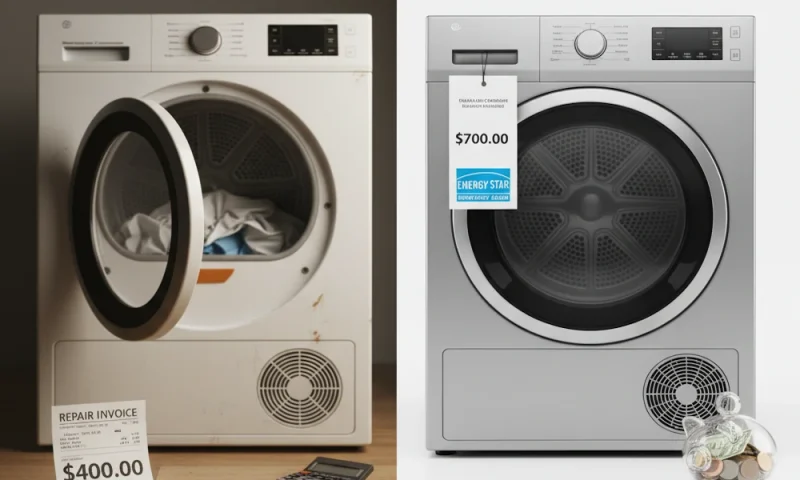
Let’s say your dryer repair is quoted at $400, and a new one costs $700. In that case, replacement is the smarter move.
But if the issue’s minor like a worn belt or a broken door latch costing less than $150, then repairing it could buy you several more years of solid performance.
Pro Tip from Bob: Always get a written estimate before deciding. Also, keep in mind that in most cases, calling an appliance technician to look at your machine involves a fee (I personally charge $85 per visit). However, the top appliance repair companies in Atlanta will usually waive the fee if you decided to have your appliance repaired by them.
Description: on the left, a repair bill for $400 beside a worn-out dryer with a few tools scattered nearby; on the right, a sleek new dryer with a $700 price tag
Step 2: Check the Age of Your Appliance
Appliances are like cars, they don’t last forever, and some brands or models wear out faster than others. Last but not least, it all depends on how well you take care of your appliance as well.
Here’s a quick cheat sheet:
| Appliance | Average Lifespan |
| Refrigerator | 10–13 years |
| Dishwasher | 8–12 years |
| Washer | 10–12 years |
| Dryer | 10–13 years |
| Oven / Range | 13–15 years |
If your machine is over a decade old and giving you trouble, chances are it’s nearing the end of its run.
Bob’s Take: Think of it like this, if your fridge were a dog, a 12-year-old one is a senior. You can still love it, but it might need more “vet visits” to keep it running. While an appliance is not a loved pet, is it worth your time, and frustration to keep repairing it or is buying a new one better option?
Step 3: Factor in Energy Efficiency
There is a considerable difference in terms of energy efficiency between a newer fridge and an older one. For example, most fridges built in 2010 use around 600-800kWh per yearv. Today, a 2025 fridge uses around 350-450 kWh per year. That means potentially saving about $80 per year on your electric bill.
In short, older appliances are energy hogs.
Modern appliances are built with Energy Star efficiency, using far less electricity and water. That means smaller utility bills, quieter operation, and a cooler kitchen (literally).
If your monthly energy bill has been creeping up, your old fridge or washer could be part of the problem.
Real Talk: I’ve replaced 20-year-old fridges that ran nonstop like a freight train. Newer models run smoother, cooler, and cost less to operate, especially over the long haul.
Step 4: Size Up the Severity of the Problem
Not all appliance breakdowns are created equal. Some issues are quick fixes; others are warning signs that your appliance is on borrowed time.
Usually Worth Repairing:
- Broken door latch or seal
- Clogged dishwasher filter
- Simple electrical issues or wiring faults
- Worn belts, rollers, or switches
Usually Worth Replacing:
- Failing compressor or sealed system (especially on older fridges)
- Cracked drum or tub in washers/dryers
- Major control board failure on outdated models
- Multiple problems showing up at once
Step 5: Consider Features and Lifestyle Upgrades
Be honest, are you still using a washer with a single knob that says “cold, warm, hot”?
Appliances have come a long way. Today’s models have self-diagnostic features, smart sensors, and even Wi-Fi alerts that tell you when something’s off.
Replacing an appliance can be an upgrade in convenience, not just a repair decision.
For Example:
A new smart dishwasher can detect clogs before they cause flooding and actually send an alert right to your phone. That’s not a gimmick; that’s peace of mind.
Step 6: Get a Professional Diagnosis
Even if you’re handy, it’s worth calling a qualified appliance repair technician for an expert opinion.
A short diagnostic visit can tell you whether your issue is something simple like a sensor or switch or something major, like a dying motor.
At Handyman Bob’s Appliance Repair, I always give my customers an honest breakdown:
- What’s wrong
- How much it’ll cost
- Whether I’d personally fix it or replace it if it were my own
That’s the kind of transparency you deserve.
Bob’s Story: The Dryer That Wasn’t Worth Saving
A few months back, I got a call from a homeowner in Decatur. Their dryer had stopped heating, and they figured it needed a new element. Easy enough, right?
When I arrived, I ran a full diagnostic and found a burned-out heating element, a failing motor, and a cracked drum that was starting to grind against the housing. Basically, this old dryer had seen better days and was running on borrowed time.
The repair bill would’ve been about $450 for parts and labor. A comparable new dryer? $650–$700, with a full warranty and better efficiency.
I laid out the numbers and told the homeowner,
“If it were mine, I’d thank this old dryer for years of service and retire it gracefully.”
We had a good laugh, and they decided to replace it. Two days later, they sent me a photo of their shiny new dryer and said their laundry room had never been quieter.
Lesson: Sometimes, replacing an appliance is like saying goodbye to an old car. Tough, but necessary for your wallet and sanity.

Final Thoughts – Bob’s Bottom Line on whether to fix or replace Appliance.
Here’s my rule of thumb:
If the appliance is under 8 years old and repair costs are less than half the price of a new one, fix it.
If it’s older, inefficient, or has already had multiple repairs, replace it and start fresh.
And hey, if you’re still not sure, call your friendly neighborhood repair guy (that’s me, Bob!). Sometimes all it takes is a professional diagnosis to make the right call.
FAQ: Repair or Replace an Appliance
Is the 50% rule always right when it comes to replacing an appliance?
No. It is a quick rule of thumb. A better version is: if the repair is a large share of replacement cost AND the appliance is already past the first half of its typical lifespan, replacement is often the safer bet financially.
What is the typical lifespan of major appliances?
Lifespans vary by brand, model, and usage, but published averages are a helpful baseline. One widely cited NAHB study reports approximate averages like: refrigerators ~13 years, clothes dryers ~13 years, gas ranges ~15 years, dishwashers ~9 years, and microwave ovens ~9 years.
What repairs are usually not worth it on an older appliance?
Major, high-cost repairs late in an appliance’s life (for example, multiple failed components, major motor failures, or expensive electronic control issues) can quickly exceed the value of the unit. If the appliance has had repeated repairs recently, replacement is often the calmer path.
How can I estimate whether a newer appliance will save money on electricity?
Use the EnergyGuide label (kWh/year) if you have it, or estimate usage and cost using the U.S. Department of Energy method: estimate daily kWh, convert to annual kWh, then multiply by your electricity rate ($/kWh) to estimate yearly cost. Compare your current unit to a newer model to see potential savings.
Should I repair if the appliance is under warranty?
Usually, yes. If parts and labor are covered, repair is typically the best deal. Check the manufacturer warranty, any retailer extended warranty, and any home warranty coverage before paying out of pocket.
When should I stop using the appliance and call a professional right away?
Stop and get help if you notice sparks, burning smells, electrical arcing, a gas smell, or significant leaks near electrical components. Safety comes first.
Sources and further reading
- U.S. Department of Energy (Energy Saver) – Estimating Appliance and Home Electronic Energy Use: https://www.energy.gov/energysaver/estimating-appliance-and-home-electronic-energy-use
- National Association of Home Builders (NAHB) – Study of Life Expectancy of Home Components (PDF): https://www.reservedataanalyst.com/mt-content/uploads/2019/10/national-association-of-home-builders-life-expectancies.pdf
- Consumer Reports – Repair or Replace tool: https://www.consumerreports.org/repair-replace/
- Consumer Reports (Press Release) – Insights on when to repair and when to replace: https://www.consumerreports.org/media-room/press-releases/2014/01/consumer-reports-offers-insights-on-when-to-repair-and-when-to-replace/
Note: Prices, parts availability, and energy rates vary by location and model. Use this guide as a decision framework and confirm specifics with a qualified technician.
About the Author